

SIPS TECHNOLOGY: THE EMERGENCE OF WOODEN BUILDINGS BASED ON STRUCTURAL INSULATED PANELS WITHOUT REINFORCING RIBS
In addition to wood-frame panels, another panel technology is now widely used. This is the structural insulated panel (SIP) technology, which was developed in the USA. The fundamental difference between the panel developed by Captain J.G.C. Döcker and the SIP panel lies precisely in its construction.
Modern SIPs contain no wooden frame or other structural wooden elements. At the beginning of this technology’s development, when sufficiently strong insulation was not available, wooden studs were indeed part of the panels. However, with the advent of polystyrene, SIPs panels are manufactured such that a wood-based structural board is bonded to both sides of the rigid insulation, which forms the core of the panel.
The first SIP panel used
According to available information, the Forest Products Laboratory (FPL) in Madison, Wisconsin, and architect Frank Lloyd Wright worked on the development of structural insulated panels almost simultaneously. In the 1930s, in response to the global economic crisis, F.L. Wright designed affordable homes he called Usonian houses, which were not to cost more than $5,000. These were single-story structures without basements, mostly L-shaped, built from brick, concrete, and wood. Some of them utilized the very first SIPs panels. These panels were manufactured by bonding a core of several layers of plywood with a plywood shell.
Testing the technology took decades
In 1935, experiments began at the Forest Products Laboratory in Madison. The goal was to transfer the vertical load of building structures to the shell of a sandwich panel, which consisted of plywood. This concept made it possible to produce a sandwich panel with insulation throughout its entire cross-section, thus eliminating thermal bridges caused by a wooden frame. The production of such a panel did not require a lumber drying kiln or carpentry technology for manufacturing a wooden frame. Furthermore, a panel without a wooden frame or other reinforcing wooden ribs can be cut to any size while retaining its mechanical properties. This means it is easy to use on-site and adapt the panel to the architecture. As early as 1935, FPL built a series of the first experimental houses to test the principles of SIPs technology. In 1947, FPL built another experimental building, which was tested for 31 years.
SIPs panels gained traction 60 years ago
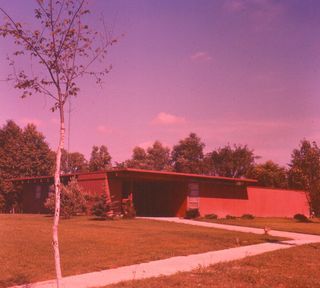
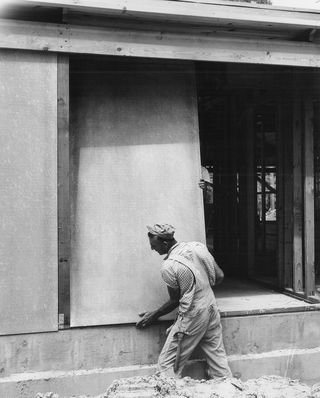
In 1952, F.L. Wright’s student, architect Alden P. Dow—son of the founder of the Dow Chemical Company—built houses using SIPs panels in Midland, Michigan. The panels used for these houses already had an expanded polystyrene core and are generally considered the true beginning of SIPs technology.
The oil crisis helped fuel the rise of the technology
From the 1950s to the 1970s, the production of SIP panels in the U.S. proceeded with mixed results. Manufacturers expected large profits but faced resistance from the conservative construction market. During this period, a number of research reports were published, and SIPs technology slowly began to find its way into building codes. The 1973 oil crisis highlighted the need to conserve energy in manufacturing, construction, and even in the actual use of buildings, which in fact greatly helped to promote this construction system.
The Breakthrough of OSB Panels
The introduction of OSB boards in 1981 provided significant support for the structural insulated panel. By bonding OSB boards to a polystyrene core, a modern structural insulated panel without reinforcing ribs was created, as we know it today. In 1990, SIP manufacturers and processors merged into an association called the Structural Insulated Panel Association (SIPA). In 2009, association members produced nearly five million square meters of panels. Since 1995, SIP technology has also been gaining ground in the Czech and Slovak markets. Here, too, it represents the most advanced method for constructing prefabricated wood buildings.
Both wood-framed panels and structural insulated panels have their own history and have established themselves on the market because they were able to offer the same or higher added value than competing building systems. Those who developed both prefabricated panel systems likely had no idea they were working on systems for the 21st century. Today, however, it is abundantly clear that modern panel timber buildings are precisely the ones that meet the requirements for a modern home: an excellent indoor climate, outstanding thermal performance, low operating costs, rapid construction, and the lowest possible energy consumption during manufacturing and construction (the least possible environmental impact).
In conclusion to our miniseries, I would like to thank Ms. Cecílie Krejcarová for lending me her excellent thesis, which served as the primary source for compiling the history of prefabricated timber-frame buildings. I obtained information on the history of SIP technology from the SIPA association. I would also like to thank the Alden B. Dow Museum in Midland for sending the materials and for granting permission to use them.